I'm a toy lover at heart, though it's not something I talk about here very often as this is more of a travel blog. How fortunate when a rare occasion presents itself that allows me to talk about both in tandem.
When the controversy became national news (oddly at the time of the retirement announcement as opposed to when the claims of racism first appeared…I guess perceived corporate defeat makes for sexier headlines than perceived corporate bigotry), TJ, who rarely encourages but simply tolerates my passion for toys, said "Oh, maybe you should buy that." I left dust clouds in my wake as I rushed out the door. I tried two Targets, one Toys R Us, and even a Barnes & Noble before heading home with my head hung low in defeat. It was only then that I tried to look on-line and found one available on Amazon.com at retail price. Sold!
I always meant to blog about the set, as I found the controversy surrounding it to be delicious. But then I didn't. And then January rolled around, and I suddenly found myself at the scene of the alleged crime.
As you can see, the toy kind of looks like the CGI movie palace…and neither look anything at all like the Hagia Sophia...


As you can see, the toy kind of looks like the CGI movie palace…and neither look anything at all like the Hagia Sophia...
Anyway.
When the Norwegian Jade pulled into port on January 13th, 2014, one year had passed since the whole sordid affair had begun. (And yes, I realize almost half a year has passed since the Norwegian Jade pulled into that port. I'm going to try to wrap this long-winded and much-delayed story up by Wednesday).
When the Norwegian Jade pulled into port on January 13th, 2014, one year had passed since the whole sordid affair had begun. (And yes, I realize almost half a year has passed since the Norwegian Jade pulled into that port. I'm going to try to wrap this long-winded and much-delayed story up by Wednesday).

Our ship docked somewhere on the west bank of the Bosphorus, a strait that forms part of the boundary between Europe and Asia. See that bridge, off in the distance? I took this grainy photo from the lido deck of the Jade. To the left (west) is Europe. To the right (east) is Asia. It's not too often that you see such a sight.
Although Ankara holds the title of the nation's capital, Istanbul acts as the cultural, economical, and historical heart of the country. With a population of over 14 million, Istanbul is the most populated city in not only Turkey, but all of Europe. (Approximately 1/3 of the city's population is on the Asia side, and I'm not at all certain how that plays into population in regards to Europe, but hey, let them have their bragging rights.)
Istanbul wasn't always known by that name, however. When Constantine the Great became the emperor of the Roman Empire in the year 324, he formulated plans for a new Christian city that would become ultimately become capital of the Byzantine Empire/Eastern Roman Empire. That city was named Nea Roma, more commonly referred to as Constantinople. It was built over the ruins of the Greek city Byzantium. When the city was conquered in 1453, it became capital of the Ottoman Empire and ultimately earned its current name.

- Moses's staff
- Abraham's cooking pot
- Hair from Muhammad's beard
- Muhammad's swords and bow
Now, as is always the case for locations of historical/Biblical significance, one must make up one's own mind as to whether or not these artifacts are truly what they are portrayed as being. What I do know for certain is that, the continuous recital of the Quran provides a serene and eloquent backdrop to one's exploration of the gallery space.


(Right): The Sultan is reported to have had the custom of breaking his fast under this terrace during the fasting month of Ramadan, which coincidentally begins tonight. Ramadan Karim to all of my Muslim friends. Love you!


Up next was a quick photo op outside of the aforementioned Hagia Sophia Mosque (though we wouldn't enter until the next morning)…

…and then we were off to the Grand Bazaar!
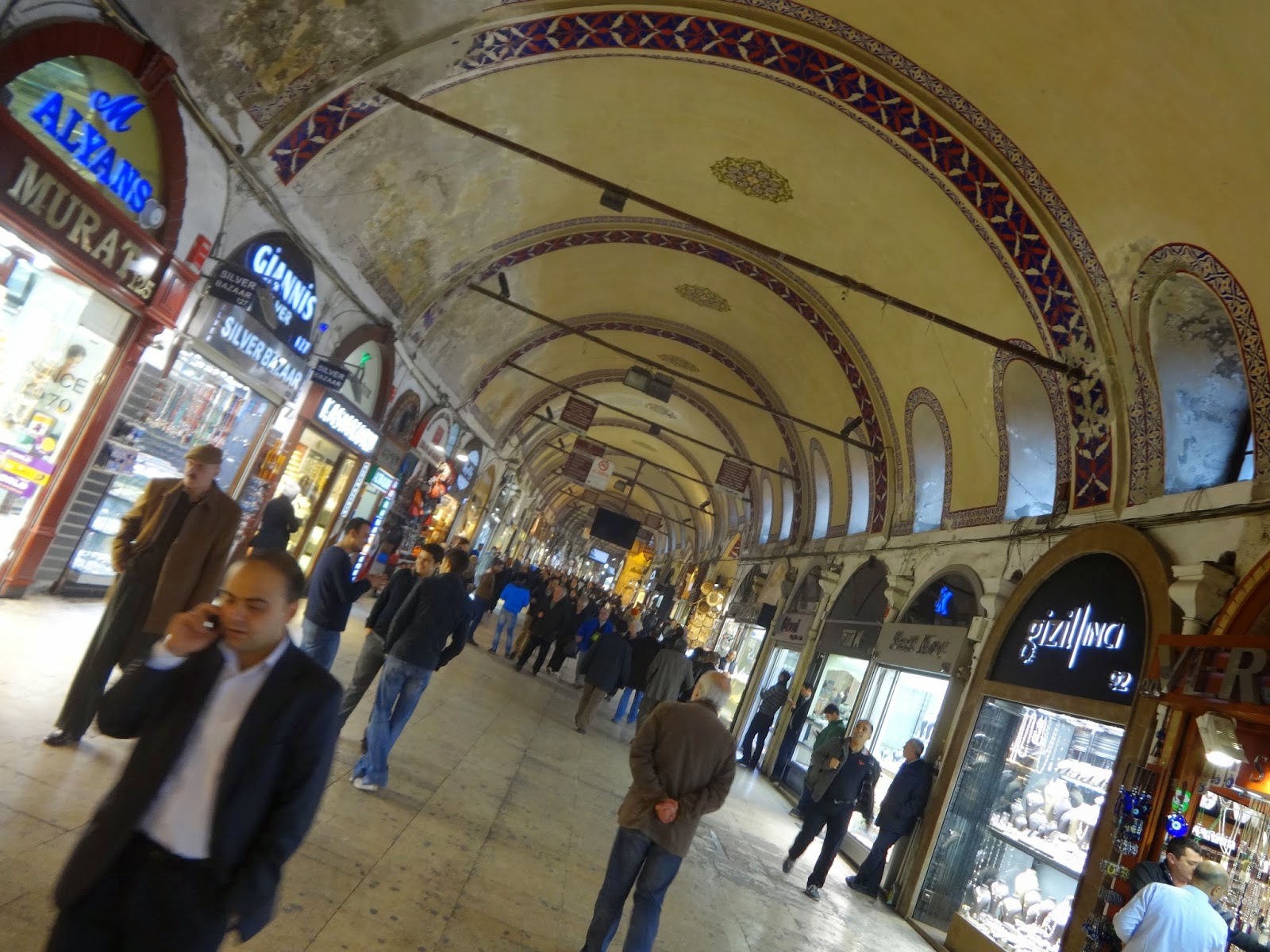

We stayed just long enough to get completely stressed out by the crowds and overeager vendors, and to buy some Turkish Delights for coworkers. Okay, okay. We also bought several boxes for friends and family, but the only ones that made it out of the house were the two for our coworkers and my parents. YUM.
As if to make up for the utter disappointment that was the Athens Hard Rock experience, the new franchise in Istanbul seemingly opened a few days prior to our arrival. The food was, as always, an amazing reminder of American bar food at its finest (with the American novelty of free refills!), and I got my darned shot glass. Snapped some random but fun street shots along the way.


That was pretty much it for the first night. We freshened up and tried to enjoy an evening out and off of the boat, but the nightlife wasn't all it was cracked up to be, especially on a Monday night. Perhaps we'll give it a go some other time on a long weekend. All of our coworkers in Jerusalem rave about the Istanbul night scene. The city itself is definitely beautiful enough to warrant a second pass-through. And speaking of second pass-throughs…
We started our second and final day in Istanbul by heading underground. The Basilica Cistern is a 70mx140m water reserve constructed in the 6th century at the height of the East Roman Empire's prosperity. The columns and capitols are mainly Ionic or Corinthian…and then there's this swirly alien thing to the right...


 services have concluded. I believe TJ and I were the only visitors to honor that request. Most people snapped away, many with the aid of distracting flash equipment. To our horror, several tourists could be seen kneeling on the carpet and pretending to pray while their companions took souvenir photos of the event. More horrifying still, these tourists didn't even bother to face Mecca while doing so, further demonstrating their lack of respect and understanding for the faith of their hosts. But hey, it made for a better photo, right? I was nearly in tears as a small, dignified employee knelt down to politely ask that a tourist cease taking photos. When the service concluded, an announcement was made inviting any visitor that had questions about Islam to step forward. Of course none did. They already had their photo op. TJ and I sat in stunned, saddened silence for a few minutes, allowing our eyes to take in the beauty of our environment, hearts breaking ever so slightly.
When people so flagrantly disrespect you and your religion to your face, maybe it's not such a far stretch of the imagination to think they would consider doing so in the toy aisle.
The only other unusual characteristic to note would be the two Medusa heads. Nobody is quite sure where they came from, or why one head is upside down while the other lays on its side, but scientists are in agreement that they were most likely laid that way on purpose. It is theorized that they were ransacked from a late Roman era building and brought here.
Definitely a cool stop, but Pool of Arches wins Cistern of the Year for the boat ride alone.
Returning to street level, we finally made our way inside the Hagia Sophia Mosque. The church-truned-mosque-turned museum is a treasure of both the Byzantine and Ottoman Empires. It apparently makes an appearance in Dan Brown's "Inferno," but I've yet to recover enough from "The Lost Symbol" to give it a go.
Mosaics depicting Mary, Jesus, and various saints adorned the walls of the Hagia Sophia during the Byzantine period. They were either ransacked during the crusades or plastered over during the Byzantine era. When Hagia Sophia became a museum in 1934, work began on recovery and restoration of the mosaics. Below are three stunning examples, including one artist rendering of what a completed mosaic may have looked like.
We next ventured across the courtyard to the famous Sultan Ahmed Mosque, more popularly known as the Blue Mosque for the blue tiles adorning the interior walls. I was unable to take photos during our walkthrough, as there was a prayer service in progress. The mosque leaders are kind enough to allow entry to outsiders during prayer time but do request that guests refrain from taking pictures until after
When people so flagrantly disrespect you and your religion to your face, maybe it's not such a far stretch of the imagination to think they would consider doing so in the toy aisle.