Showing posts with label Negev. Show all posts

Monday, August 18, 2014

Mitzpe Ramon and the Best Birthday Ever!


When we travel, whether it be a short weekend trip or an extended getaway, the one thing we tend to always cheap out on is the hotel room.  (Oh, yeah, and the flight, too.  No economy seat is too good for us, no sir.)  Our philosophy is that the room is just for sleeping, so why spend unnecessary amounts of money on something you're barely going to look at?

My last birthday was the exception that has made us see the light.

When we lived in Guadalajara, we always spent TJ's birthday weekend in Puerto Vallarta, while my cumpleaños always seemed to be represented by a peaceful weekend at home.  TJ decided that, this time around, my birthday would receive the getaway treatment.  But where to go?

Several of our coworkers had already taken weekend trips to, and raved about, the Beresheet Hotel in Mitzpe Ramon.  And that's just where we spent the weekend of March 21st-23rd.


The Beresheet Hotel is part of the Isrotel Exclusive Collection, which basically means it's one of the chain's more exquisite offerings (and future weekend trips would sadly prove that hotels not in the Exclusive Colleciton were…not so exquisite…).  

The amazing accommodations featured a comfy queen bed and a full living room...


and a private infinity pool!!!


The hotel featured two delicious Kosher restaurants; The Lobby Bar offers a selection light dairy meals, while the Rosemary Restaurant offers a gourmet meat buffet. 


Beautiful, right?  Now, I'm not sure why I know anything about this town beyond what was to be found at the hotel, but we somehow managed to drag ourselves away for a bit of sightseeing and exploring.

The hotel is located on the edge of the towering cliffs that slope down into Makhtesh Ramon, a crater running 24 miles long, 5 miles wide, and 1600 feet deep. which was the next stop after Moa on the old Nabatean Spice Route.  The term "crater" is a bit of a misnomer, as such language would indicate that this land formation was the result of a meteor impact.  Instead, this makhtesh (the world's largest) was created by erosion.  A geological landform unique to Israel's Negev desert, a makhtesh has steep walls of resistant rock surrounding a deep closed valley.   

We awoke bright and early on Saturday morning and took in the breathtaking sight of sunrise over the makhtesh.  The world transformed before our eyes, rapidly changing from black, to purple, to blue, yellow, and orange.  


Following the sunrise and some serious caffeine infusion, we headed over ot the Mitzpe Ramon Desert Sculpture Park, located conveniently right beside the hotel.  Just like it sounds, this is basically a park, located in the desert, that has the occasional sculpture thrown about for good measure.  I don't believe we managed to navigate the entirety of the park, but we got the gist.  And now, so have you!


Making our way back toward the hotel, nature provide a perfect segue into our next activity.  Standing next to a sculpture was an Ibex mother and her kids.  


Now, being wild, aggressive animals with pointy horns, we opted not to pet them.  

But we DID pet the animals at the Mitzpe Ramon Alpaca Farm!  Would you just look at that segue!  BAM!  This seemed like a good use of time, as we love petting fluffy animals, and TJ had been a fan of alpacas since his trip to Ecuador.  I'm not sure what I expected, but it should have been a rundown family operated farm filled with filthy alpacas, llamas, and camels that wanted nothing more than to spit on me.  Don't take that as a criticism, as it was a lot of fun and an excellent use of time.  


I was happy to, after six months living in the Middle East, finally interact with a camel...


while TJ was overjoyed to have met Carol Channing.
  

We concluded our day with some exploration of the makhtesh itself before heading back to the hotel for more swimming, eating, and living in temporary luxury.  The crater and surrounding area forms Israel's largest national park, the Ramon Nature Reserve.


Ha-Minsara (The Caprentry Shop)


The next morning was filled with even more swimming, eating (I'm telling you, this hotel has the most amazing food), and living in temporary luxury.  I was treated to a birthday massage at the hotel's spa right before checkout.  Afterward, TJ met me in the lobby with a gift basket filled with massage oils, a tea light/aromatic oil burner, and enough oils to last until my next birthday.  

It was the best birthday of my entire life and is still my favorite weekend in Israel.  I could honestly gush about it enough to fill another post.  Maybe I will…if a certain someone would like to take me for a repeat visit next year...  

Tuesday, August 12, 2014

Moa

After much discussion on how great it would be, on February 22nd we finally took our first Israeli desert hike.  Our pup Zelda and a handful of coworkers from Jerusalem and Tel Aviv were along for the ride.  A fun day of hiking, sweating, gulping fresh water, almost falling off of humungous hilltops (mini mountaintops?),  and picnicking was had by all.   


Because I have this base need to be informative, and the internet isn't exactly overflowing with information about Moa, what follows is basically a transcription of a plaque located at the ruins of an ancient Nabatean fortress that we explored that day.


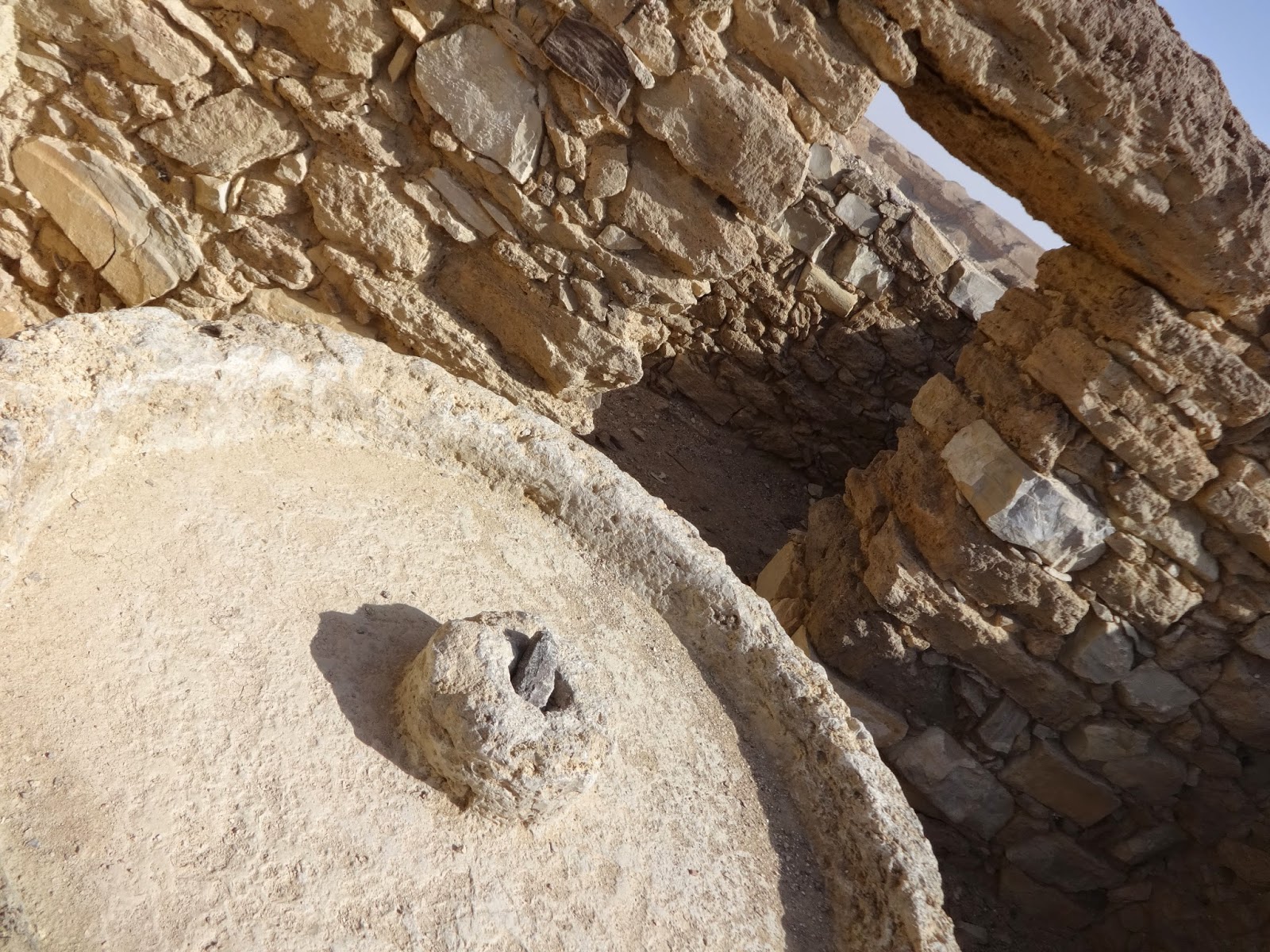
Moa, located in Israel's Negev desert, is but one of many stops on the ancient Nabatean incense route.  The Nabateans were an ancient Semitic people who inhabited northern Arabia and the Southern Levant.  Nabatean merchant caravans arrived at Moa after crossing the Arava Desert.  Moa contains the remains of an ancient Nabatean fortress, agricultural installations, an aqueduct, and an olive press used in the extraction of oil for the production of perfumes.  


The station was established in the third century BCE by the Nabateans, who were known for their ability to not only survive in the desert but to make maximum use of it.  They earned their living providing pastures for camels, sheep, and goats, and they accumulated great wealth from the sale of perfumes on the international market.    They were a free people who found shelter in the desert during times of  unrest.  They knew how to hoard water in simple but ingenious ways, and built hidden underground reservoirs with plastered walls that assured a secure water supply.  They knew how to lead convoys in the desert and to the seas, and thus controlled the incense routes.  Their prosperity and economic success greatly influenced their culture and lifestyles and so from desert nomads they became permanent residents of urban settlements.  They left behind the impressive ruins of their towns, especially those of Petra in Jordan, which is number one on the must-see-before-we-leave-list.


The Nabatean settlements were spread out over the land in such a way that they could efficiently maintain the spider web of routes crossing the Negev.  The towns were spaced approximately 35km apart, as this is the distance that a camel can travel in one day.  From Moa, the main route continued a short distance passing the Neqarot fortress to the next route station, which was Saharonim khan at Ramon crater (Makhtesh Ramon).  I happened to spend my birthday at this very crater, exactly one month later, and we will visit that experience in a future post.


Moa was abandoned in the third century CE, probably because of the outbreak of an epidemic.  The residents left behind them the biggest, most impressive and best preserved archaeological site in the Arava.  The site was proclaimed a world heritage site by Unesco together with the four central Nabatean cities of Avdat, Mamshit, Shivta, and Halutza.  These settlements preserve a unique desert culture based on a mutually beneficial relationship between man and his environment, and a deep acquaintance with the desert as well as a unique ability to survive in it.