Saturday, October 20, 2012

Guadalajara's Top 20, Number 19: Mirador de Huentitan (Well, Sort of)

In my rush to complete the Top 20 list, things have become increasingly difficult.  Our Jeep Compass was in the shop for maintenance for almost an entire week, severely limiting my ability to travel.  We've had to spend time packing, donating, and throwing things away.  We have to clean the house and do some yard upkeep.  Plus, there's this little thing called work that really gets in the way for eight or so hours every Monday-Friday. 

In hindsight, I should have been more assertive in getting this done before the last minute, but what can ya do?  Time travel?

The next item on the list is Mirador de Huentitan, and I'm totally gonna cheat on this one.  

Mirador de Huentitan can be found at the end of Calzada Independencia Norte.  It overlooks the famous Barranca de Oblatos, a canyon 16 miles long and 2-5 miles wide, with an elevation of over 3,400 feet.  The beauty of the canyon is said to rival that of the Grand Canyon itself and it was the site of many battles in the Mexican Revolution.

Barranca de Oblatos has another name, Barranca Huentitan.  Mirador de Huentitan is, therefore, nothing more than a lookout point for the canyon itself, which can be seen from many vantage points, among them the backside of the Guadalajara Zoo, which we visited way back in January 2011 and again when our Texas friend Patrick visited in September 2011.


So, there ya go folks.  It's not exactly the Mirador de Huentitan, but I've seen the Huentitan, aka Oblatos, twice already.  No sense in going back now, is there? Not when there's one more site to see on the list.  And I'm on my way there now...

Guadalajara's Top 20, Number 18: El Baratillo (But Really Mercado del Día de Muertos)

Regarding El Baratillo, our Top 20 Guide says that "The little cheap place" is a Sunday flea market operating with an emphasis on cheap clothing and hardware.  It advises that you can find a good deal, but it's best to arrive before 10:00AM in order to do so.  It provides the address, Juan R. Zavala (aka Calle 38), north of Javier Mina.

Regarding El Baratillo, my local Mexican friend say: 

"That market has a reputation for selling stolen merchandise."  
"That could be the last thing you do.  Not in Guadalajara.  I mean, ever."
"It's not that everyone that goes their dies, but..."
"It's not safe for a blue-eyed gringo like you."


Needless to say, I have no interest in getting robbed, beaten, or killed during my last weekend in Guadalajara.  The likelihood that something would happen is minimal, but when the locals say it's not a good idea, I'm going to heed their advice.  Instead, I opted to accompany a handful of my coworkers on one last outing yesterday, my final day at work.

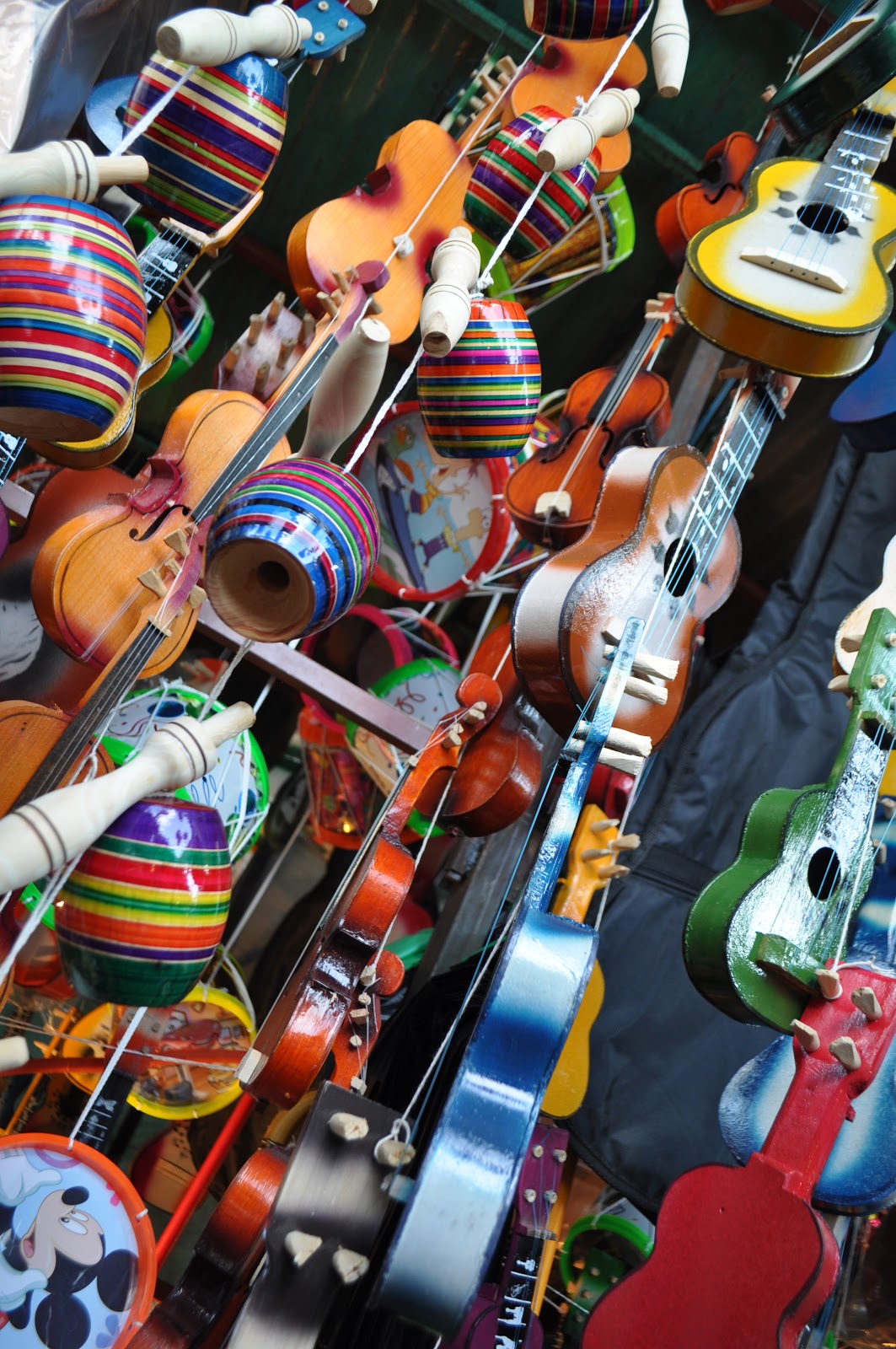
Día de los Muertos (The Day of the Dead) will occur at the beginning of November and Mercado del Día de Muertos (The Day of the Dead Market) has opened in anticipation of the big event.  Our current CLO office (who, I like to stress, is not responsible for the sketchy Top 20 list) organized this excursion so that consulate families could experience the market and stock up on decorations.  


We arrived in Guadalajara the week after 2010's Day of the Dead celebration.  Last year, we were on vacation out of the country.  And this year, due to scheduling demands back at the Foreign Service Institute, we will be leaving Mexico the week before.  I'm happy to have the opportunity to visit this market, because this is one holiday I've been, pardon the pun, dying to blog about.  


The Day of the Dead is a Mexican holiday (though it is celebrated around the world by various cultures) that focuses on gathering friends and family to pray for and remember loved ones that have died. 

People will visit cemeteries to spend time with the souls of the departed.  They will build altars in their homes and fill them with photos, mementos, and the favorite foods and beverages of the deceased, all to encourage visitation by the loved one's spirit.  Toys are bought for dead children, bottles of tequila for adults.


Sugar skulls adorn the altars and provide sweet treats for the living.   Figures of the skeletal remains of a well-dressed woman act as the primary mascot of the Day of the Dead, these women, known as Catrinas, are based on a 1929 zinc etching by José Guadalupe Posada, known as La Calavera Catrina ('The Elegant Skull').

Catrinas can be found in all shapes and sizes.  Guadalajara typically chooses a theme and then sculptures invade the city centers.  Last year, the Catrinas had a Pan American Games theme, with all skeletons caught up in some sort of sporting event.  In this particular market, these tiny ornamental Catrinas dominated the scene.  

When we arrive in Jerusalem and have our house set up, I'll share pictures of all of our Mexican art and knick-knacks, among them two beautiful Catrinas that we picked up along the way, and a couple of items I grabbed at the market yesterday.  Yes, I know that will be a long wait, but I'm excited to share nonetheless.  Once upon a time, I wondered whether or not moving every couple of years and living in government housing would allow for creating a unique and personal living space, and I am pleased to report that it is entirely possible.  Each new assignment will enhance that space, and I can' wait to share it with you.  I could do it now, but I like the notion of revisiting Mexico with you sometime.  Plus, we plan to paint the walls in Jerusalem, so those photos will be much prettier than what I could manage now on the standard white.  


Foreign Service life is really quite cyclical in that you end your post where you began:  Personal effects en route somewhere, sleeping on government-provided mattresses, internet and phone accounts cancelled, and sitting at Starbucks updating your blog.  Or maybe that's just me.  Either way, today I''m typing at you while enjoying an Iced Caramel Mocha, Starbucks Mexico's 10th anniversary beverage, and a big loaf of Pan de Muerto, the official bread of the Day of the Dead.  The ridges along the top are supposed to represent the bones of the deceased.


Well, that's not creepy at all, is it?

Wednesday, October 17, 2012

Guadalajara's Top 20, Number 17: Parque Agua Azul


This afternoon I made my second visit to Parque Agua Azul, a vibrant city park with a tiny splash of zoo life thrown in for good measure. 


Accompanying me today was my friend Osvaldo, who I had not seen in quite a while.  We arrived shortly before 5:00 and made our way over to the aviary...which had just closed.  I thought this was going to turn into yet another complaint about the Top 20, but Osvaldo turned on the charm and begged the attendant to let us in, because his friend had just travelled allllll the way from the United States and wanted to see the birds.  It wasn't exactly precisely true, but it did the trick and we got to spend a few minutes amongst the parrots and ducks.


We then headed over to the Butterfly House which had also just closed.  This particular attendant didn't need a sob story; he just told us to make it quick.  And quick we were, because there were no butterflies...in...the...Butterfly...House?  I wasn't disappointed, but rather expecting it:  A previous visit to the park had only provided two butterflies, one of which was outside the house.  I still like it because it looks like EPCOT.


Making our way over to the large pond Osvaldo was surprised to find that it had been drained.  I, however, was not shocked; it's how these blogs tend to go lately.  It's okay, though.  I will never be able to erase the memory of my last trip to the park, in which I saw diaper-clad toddlers splashing around in, and sometimes drinking, the murky duck-poop infested waters of the pond as their parents smiled and watched from the bank and TJ and I stood slack-jawed and horrified.  I imagine some of them have since died form mysterious ailments.  I would like to think that the lack of water today indicates a good scrubbing is in progress.


There's not a whole lot to say about the place.  A park's just a park, after all.  But families crowd the place on weekends and toss frisbees around while noshing on picnic lunches.  Teenagers come here to make out.  Supposedly, there is live music on Sundays.  A trolley is available for tours of the park.


There's also beautiful cactus garden.  See?


After a long jaunt through the park in which we talked about tv shows and relationships and family and careers, we stopped at a neighborhood coffee shop and talked some more about the very same.  He then remembered that he had forgotten to do a project for his internship and we walked over to a jogging trail and I watched as he futilely begged women to film a mock Asics sock commercial with him.  We then parted ways, with him giving me a hug and a friendship bracelet and me inviting him to come visit in Wasington, D.C.  

With only five days left in beautiful Guadalajara, these are the moments I want to remember.  Not ticking off items on an arbitrary list, but rather appreciating the moments spent with the people I would never have met if not for TJ's chosen career path.  As much fun as the park was, it was the company that made the day.

Tuesday, October 16, 2012

Guadalajara's Top 20, Number 16: Museo Orozco


The next item on our Community Liaison Office's Top 20 list is Museo Orozco, located at Aurelio Aceves #27.  Frequent readers may recognize the Orozco name from here and here.  I've spent the past two years stumbling across Jose Clemente Orozco in one way or another, the entire time looking forward to the day that I would finally visit his museum.  TJ, on the other hand has been fighting my urges, going so far recently as to suggest that anything on a so-called Top 20 list that hadn't been naturally stumbled upon within a two year period probably isn't worth seeing at the last minute.  Recent experiences here and there have proven him all but right, and I had to beg him to go with me to the museum on Saturday.  

Only we didn't get to go on Saturday.  Despite on-line hours of operation stating that the museum would be open at 10:00, it didn't actually open until noon.  TJ was amused.  I was not.  We had lunch plans that conflicted with the later opening so we had to delay our visit until this afternoon. We returned shortly before 5:00 today and I was concerned that we wouldn't have time to properly explore, as the museum closes at 6:00.

I shouldn't have worried.  


The museum, formerly the home and studio of the artist, features only one solitary painting by the man himself.  It hangs in  the foyer, which has been converted into classroom space.  Much to my surprise, this facility is more community center than museum, hosting a series of classes on such topics as Hispanic-American Literature, Creative Writing, and Furniture History (I am not joking).  Class was in session, so I wasn't able to view the painting or the descriptive text up close.  On the bright side, this painting looks nothing like his murals, so it's nice to get a bit of variety.  

Two other small rooms were filled sparsely with the works of a lesser known artist.  It all looked the same. 

All told, it took five minutes to walk through the museum.  Written on one wall was the following:


That sounds about right.  I am at a complete loss as to why this place made the Top 20.

TJ was right, and he knew it.

Tomorrow I will be visiting Number 17.  TJ will not be coming.  He couldn't be happier.

Sunday, October 14, 2012

Guadalajara's Top 20, Number 15: Plaza Tapatía

Our Jeep is currently in the shop getting new tires, an oil change, and several other nips and tucks to prepare her for the long drive from Laredo, TX to Falls Church, VA that we will face next week.  To kill time in our now carless existence we walked downtown yesterday and had lunch at Terra Madre, a cute little cafe in Plaza Tapatía that I've had my eye on for about two years now. 

The plaza, a pedestrian thoroughfare filled with flowers and fountains, gets its name from the word Tapatío, a colloquial term derived from the Nahuatl word "tapatiotl" that is used to describe someone from Guadalajara.  It can also be used as an adjective for anything associated with this, Mexico's second largest city.  The plaza fills nine or so city blocks and links the back of Teatro Degollado... 

with the entrance to Hospicios Cabañas.


(Disclosure:  Due to the grand scale and of this plaza, you cannot actually see both of these buildings at the same time.  They're one block over, many blocks down from each other.)
  
The plaza was conceptualized following the 1978 approval of a plan for the Urbanization and Regeneration of the Metropolitan Center of Guadalajara, the objective of which was to create open spaces for entertainment and recreation while simultaneously preserving historical monuments and solving traffic problems.  All nice and good, but these traffic problems will only be solved by bulldozing the rest of downtown, too.  But I digress.

Sitting there sipping our limonadas and chowing down on fajitas and molcajetes we were afforded two views.  One, the ever bustling entrance to Mercado San Juan de Dios, and two, the Quetzacoatl Fountain (La Inmolación de Quetzalcoatl), designed by Victor Manuel Contreras.  During our first visit to Hospicios Cabañas our friend Genaro told us that the snake head once sat atop the 82-foot tall bronze piece in the fountain's center before an earthquake knocked it loose, but the proportions seem off.  I think he was messin' with us.  If anybody knows, please share in the comments section.  


Nearby, right outside the recently opened Church's Chicken (yes, THAT Church's Chicken) is a bronze sculpture of the city's coat of arms.  A replica sits atop a fountain in Plaza Guadalajara and the imagery adorns the state flag of Jalisco.  You may also remember that it was the inspiration for Leo, the second-most awesome mascot from last year's PanAmerican Games.


Speaking of the PanAm Games, one of my favorite features of the plaza is this rose.  Guadalaja's nickname is "The City of Roses," and to celebrate the games 42 roses by artist Karla de Lara were commissioned and spread throughout the city during an event known as RosaFest.  There was one rose for each country participating in the games, each sponsored by a different business here in Guadalajara.  TJ and I spent a weekend shortly after the games scouring the city in search of all 42 roses.  We found and photographed most of them, but some were unreachable due to being in places like the airport, past the security gate.  Grrr.

After the conclusion of the 2011 Parapan American Games the roses were returned to the companies that sponsored them, to be done with as desired.  Many companies opted to proudly display the roses in front of their office space, as was the case with Plaza Tapatía's Centro Magno Joyero, a large jewelry distributor.   If I recall correctly, this particular rose was originally located at  Hospicios Cabañas.  Seeing these roses peppered throughout the city, many of which were originally dispersed throughout this very plaza, is always a treat...a reminder of one of my favorite periods here in Guadalajara.

Thursday, October 11, 2012

The Illustrious People of Jalisco

Another staple of historic downtown Guadalajara is the gorgeous Rotonda de los Jaliscienses Ilustres (Rotunda of the Illustrious People of Jalisco).  Located just to the left of the Cathedral (when viewing it from Plaza Guadalajara), the rotunda occupies space formerly reserved for the Sanctuary of Our Lady of Solitude and the Garden of Solitude.  And, apparently, a post office and telegraph building.  


That was all cleared out in 1949 to make way for this rotunda, designed by architect Vicente Mendiola, which stands as a tribute to people of distinction who helped write the history of Jalisco with their words, art and actions.  First named "The Rotunda of the Illustrious Men" upon completion in 1951, the monument's name was later changed to rightfully include important people from both genders.  

The rotunda features a quarry stone ring supported by 17 Doric columns.  Ninety-eight tombs are provided to house the remains of illustrious people, though most are currently empty.  An eternal flame stands (awkwardly enough, unlit) in the center, an intended homage to the illustrious children of Jalisco.


Lining the rotunda are various statues cast in copper that represent some of Jalisco's most distinguished citizenry.  Due to their dark color and Guadalajara's perpetual sunshine (I know, what a problem to have), it is often difficult to snap good pictures of them.  Here are three that somewhat do them justice:


(L to R):  Pedro Moreno and Rita Perez de Moreno, insurgents in the Mexican War of Independence; Jose Clemente Orozco, Mexican social realist painter.

Such a shame that I can't get good pics of them all; they truly are gorgeous.  Hopefully time and weather will wash these puppies out into a photogenic light green, Statue-of-Liberty-style.

Somebody, please call me when that happens.  With only eleven days left here, I'm already looking for excuses to return to Guadalajara and visit all of the illustrious people that I have met over the last two years.

They may not have led righteous wars or painted famous murals in historic buildings...but they are my friends.  They are doctors and scientists, lawyers and accountants.  They are the Foreign Service Nationals that welcomed us to post and showed us how to do our jobs at the consulate...and will do so again when our replacements arrive.  They are students working for a better tomorrow.  They run family businesses and help take care of their nieces.  They are our friends.

And we are going to miss them terribly.          

Wednesday, October 10, 2012

Guadalajara's Top 20, Number 14: Architecture

Architecture?  How vague is that? 

When I hear the words "Top 20" and "Architecture," my mind can't help but leap to examples of structural superiority that have managed to work their way into my heart over the years:


The Empire State Building.  The Louvre.  Centre Pompidou.  Chichén Itzá.  That funky McDonald's in Oklahoma with the golden arches that cross an interstate highway.


So when I saw that the word "Architecture" appeared on our CLO's Top 20 list for Guadalajara, my interest soared.  And then plummeted like a duck during hunting season.  


Strong in theory, this topic is sadly weak in execution...for two reasons.  One, because in a sea of historic landmarks and breathtaking cityscapes, the list only names three buildings as must-see architectural feats.  And one of them already has a separate listing (Teatro Degollado).  Two, because Santa Monica is also on the list.


Since Teatro Degollado (which,for the record, totally deserves inclusion on a list of Guadalajara's architectural feats...it's just weird that it got listed twice) has been covered lovingly and in depth already, I will take the liberty of moving forward with my scathing review of Santa Monica.


I have attempted to visit the Church of Santa Monica (intersection of San Felipe and Santa Monica, for anybody silly enough to want to go after reading what follows) on two occasions.  Both times, I was denied entrance to the church.  The first time was because they saw my camera and wanted to ensure respect was paid to the worshippers attending services inside.  Okay, fair enough.  They at least let me peak my head in.  It looked not unlike a construction zone.  The second time, there was no service to speak of.  The lights were off and the door was closed.  The frumpy attendees at the door (there were three...there are always three) directed us to a side chapel full of similarly frumpy people that were only slighly less photogenic than the house of worship itself.  The outside is much prettier, I suppose, and I guess that's really why this mess makes the list.  Built toward the end of the 17th century, the facade features fine stonework ornamentation depicting grapes, angels, eagles, and whatnot.  A statue of St. Christopher overlooks the street., presumably to make sure nobody attempts to enter the facility.  There's also some charming graffiti decorating the doors to the larger, off-limits chapel which, thanks to rotting and splitting wood, allow for a tiny peak inside.  TJ was ready to kill me after our first waste of time visit.  After the second, he demanded promises that we won't be following any Top 20 lists at future posts.  

On to lovelier things...


The final item on this unusual list, Templo de San Francisco de Asís (295 Calle 16 de Septiembre) is held in much higher regard.  This church was built by the Franciscans in the late 17th century and stands on the site of an earlier church and convent. Solomonic columns adorn the exterior, spiraling artfully toward the heavens.  The church is surrounded by beautiful gardens, and families can be seen comfortably lounging in them at any given time.  I have fond memories of this church from our early days in Guadalajara, as it was here that Los Gigantes rested in between sets...though I didn't connect the church's name and location until we arrived on-site this past weekend.  I was all like "Hey, I probably have pictures of this place already," and TJ was all like "Duh.  No more Top 20's!"     


Well, I have six more to go, and then the Guadalajara Top 20 adventure will be over.  TJ's grudgingly agreed to go along with this until conclusion, but I'm inclined to agree that, going forward, we should make our own fun. We've seen and done so many amazing things here that were so far off that list, or any guidebook, that it really makes you question the effectiveness of such travel tools.

Teatro Degollado is a wonderful building, both on merit of it's architectural design and its role in Guadalajara's performing arts circles.  But it already had a spot in the Top 20.  To toss out its name again in a general "Architecture" slot that includes the tacky Church of Santa Monica while failing to mention the aqueduct (we'll get to that in a couple of days), the Cathedral, or even one of our impressive malls is just weird and indicative that it is far past time to update the list.