Wednesday, February 12, 2014

Ramla, The Mazor Mausoleum, and Migdal Tsedek National Park

Today's topic is something that I quite frankly forgot about in the excitement of chronicling our experiences in Bethlehem, and as I try to wrap my head around January's honeymoon adventures in Europe (no, you haven't missed anything...I'll write about that shortly), I thought this would be the perfect opportunity to step back in time for a moment and revisit a fun day with friends.

After seeing the photos from our November 30th trip to Caesarea, our friend Aviv contacted us and said he wanted to go on a day trip with us as well.  Yehuda, a mutual friend of Aviv's who had joined us in Caesarea, would be coming along again.  Options were discussed, and it was decided that December 21st would be a fine time to visit a couple of small towns near Tel Aviv.


Ramla (רַמְלָה , الرملة) is a predominantly Jewish city in central Israel located 20km southeast of Tel Aviv.  The city also boasts a significant Arab population dating back to the city's founding in the early part of the 8th century by the Umayyad Caliph Suleiman.  In fact, Ramla holds the distinction of being the only city in Israel founded and originally developed by Arabs.  


Ramla was the capital of Palestine prior to the arrival of the Crusaders in the 11th century.  Following the 1948 Arab-Israeli War the majority of the city's Arab population were either expelled or fled voluntarily.  The city was repopulated by Jewish immigrants from Asia and North Africa.   


Our first stop of the day was The Tower of Ramla, aka The White Tower, a 13th-or-14th-century minaret that was built as an addition to The White Mosque, itself built in the 8th century by the Caliph Suleiman.  Although scant traces of The White Mosque remain, the six-story minaret stands as a proud reminder of what once was.  


In the northwest corner of the complex is a shrine that local Islamic tradition associates with Nabi Salih, an ancient prophet mentioned seven times in the Koran.  I took no photos of the shrine, as unruly local children saw fit to throw snowballs at me upon approach.  Yes, yes, I realize that snow is not present in any other photos within this blog post.  You just have to trust me that it was still piled up from the previous weekend. 


The site also contains three cisterns, though the entrance to each was locked.  


View of The White Mosque archaeological site from the top of The White Tower

One cistern that was open for public viewing is The Pool of Arches, an underground 8th-century reservoir located a few blocks away.  For a small fee, visitors are allowed to rent a
row boat from which to explore and admire the arches that support the small underground cavern.  The cistern was built in 789AD and the fact that it survived the severe earthquakes that destroyed much of the city, including The White Mosque, is a testament to the quality of its architecture.  The pool was built during the reign of Caliph Harun al-Rashid to ensure that Ramla had a steady water supply.  The pool was fed by rainwater from above, a spring from below, and an aqueduct funneling water from the direction of The White Mosque.  The pool was once known as "The Pool of El Anzia (The Pool of the Goats)," and held troughs for the watering of cattle.  Christians refer to it as "The Pool of Saint Helen," named after the mother of the Roman Emperor Constantine, who is traditionally thought to have ordered the pool's excavation.  


The rest of the morning was spent walking around encountering random things that I can't find any explanation for online, such as this beautiful Garden of Eden inspired mosaic...
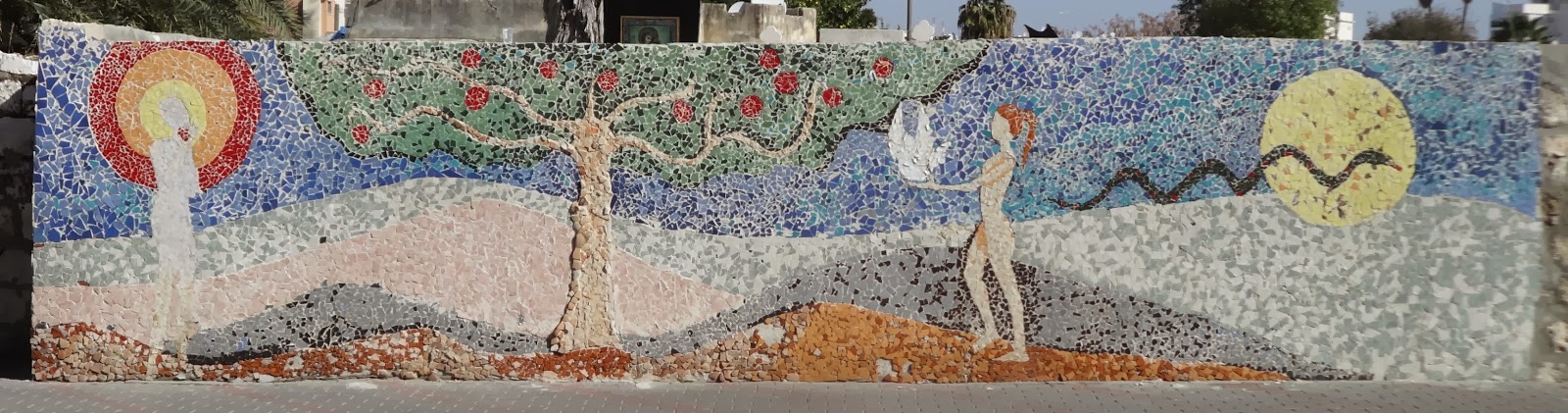

…and a small park with a coexistence-inspired motif featuring busts of several famous individuals, including John F. Kennedy.


We wrapped up our morning in Ramla with a delicious lunch at Lonely Planet-recommended Samir's, an Arab family-run restaurant featuring various kebabs, hummus and salads.  

Our next stop was Mazor National Park, located in the town of El'ad, 25km east of Tel Aviv.  It was just a quick stop to visit the Roman Mausoleum, the only Roman-era building in Israel to be so well preserved from foundation to roof.  The mausoleum was built in the 4th century to act as the burial vault for an unidentified Roman couple.  A prayer niche facing toward Mecca was added by the Muslims of the region in later antiquity.  It was at this time that the mausoleum found new life as The Shrine of the Prophet John, functioning as a mosque until the depopulation in 1948 of the Palestinian village Al-Mazaryi'a.


Upon entering the first chamber, you will find the remnants of two sarcophagi, as well as the previously mentioned prayer niche.  A second chamber contains a dovecote with approximately 60 pigeonholes, where doves are theorized to have been raised as sacrifices to the goddess Aphrodite.  


In 1949, not understanding the building's historical significance, the Israeli Defense Force targeted the structure for demolition and proceeded to use it for target practice.  The mausoleum was saved in July of that year, when an antiquities inspector arrived on the scene and prevented its destruction.  

The mausoleum sits quietly along the side Road 444 near the turnoff to Kibbutz El'ad…but in ancient times this scenic road was part of the famed Via Maris, the Way of the Sea.  This major north-south highway led from Egypt through the land of Israel into Syria. 

Our final stop of the day also lies along the ancient Via Maris:  Migdal Tsedek National Park, a beautiful and expansive stretch of land located in the western foothills of Samaria near Rosh HaAyin.


A Jewish community by the name of Migdal Afek was located here during the period of the Second Temple, but it was destroyed by the Romans in 67 CE during the Great Revolt.  The 12h century CE
saw the establishment of a fortress, called Mirabel (miraculous beauty), on the site.  Muslim conquerors gained control of the fortress in 1187, only to demolish it in 1191.  It was eventually rebuilt.  An Arab village sprung up around the new fortress in the 16th century, and by the 19th century the fortress had been renovated into a castle from which Tsadaq Jama'ini took control of the area.  Most of the excavated site is from the 19th century castle and the 12th century Roman fortress.

The fortress was a little…odd.  The main entryway appeared to be locked, but there were several other points of entry around the perimeter, ranging from fence-bent-back-by-trespassers to no-fence-at-all.  Regardless, the place was positively SWARMING with people.  Some were picnicking on the rocks surrounding the fortress.  Others were climbing haphazardly up the side of collapsing walls.  More still somehow managed to find their way up onto the roof.


I was raised not to jump off of a bridge just because everyone else was doing it, so, deciding that discretion is the better part of valor, we simply posed for poorly taken selfies on the perimeter and allowed ourselves a quick looksie inside via one of the non-barricaded entry points.  It was a quick enough glance to see that a)  The place is falling apart and downright dangerous in certain areas, and b)  There is at least some small effort at renovation/restoration in progress.  It would be interesting to return one day if/when the entire site is open for public viewing just to see what sort of progress has been made.  The most immediate concern, however, seems to be looting, as there is glaring evidence that stonework is being stolen from this largely unattended historical site.  


All told, it was an exciting day full of new sites that, frankly, we probably would not have seen had it not been for Aviv's recommendation.  All three locations were a bit off the beaten path.  I'm not sure we will ever find reason to go back to any of them (safe for Ramla, as a colleague lives there and we have an open invite for coffee sometime), but I'm thrilled to have had the opportunity to experience this tiny bit of history.  Not to mention the fact that all of that Roman history made for a nice segue into our honeymoon adventures...

Saturday, February 1, 2014

Sheleg!

Since the U.S. found itself in the midst of the second "polar vortex" of 2014 this past week, I thought it might be fun to revisit some photos and memories from mid-December that I never got around to posting here. 

As the winter season began, our Hebrew instructor provided us with some weather terminology.  It was cute when she taught us the word for snow, שֶׁלֶג (pronounced "sheleg"), because none of us thought we would be needing it here in Jerusalem.  Sure, it snowed last year, but that had to be a fluke, right?    

Wrong.  Beginning the week of December 8th, various news sources began reporting on the probability of snow.  I awoke each morning hoping to find, at minimum, a light dusting of white powder outside my window.  Every morning was fraught with disappointment.  I awoke at 7AM Thursday, December 12th, only to be disappointed once again.

I begrudgingly began the process of getting ready for work at a turtle's pace, a slow process underlined moreso by the speed and efficiency with which TJ awoke and scurried out the door.  By 7:20 he had returned, covered in snow.  I looked outside again, and in the span of twenty minutes, the ground was almost completely covered.  We received a management notice advising of a two hour delay in business operations, but it arrived so late that we knew some folks had to be in transit already.  As we lived within walking distance of work, TJ ran ahead to open the building so that any early arrivals would have a warm place to await further instruction.  I opted for a more lackadaisical course of action and meandered around the neighborhood a bit, capturing the moment for posterity.  I mean, who knew how long it would last?  


By the time I arrived at the office shortly before 9AM, the answer to that question was obvious:  It would be lasting quite a while.  The wind had kicked up, the snow was falling faster with every passing moment, and the temperature was dropping.  Even so, we were right in assuming that many of our employees had been in transit when the management notice went out:  about half of our local staff, and all but one American, were in the office.  Some of our visa and passport applicants had also decided to brave the elements, which just goes to show that a consular section's work is never done!  

Ten o'clock arrived, and instead of a delayed start, it brought news of a full-blown office closure. 

While TJ assisted in closing down business operations and assisting the handful of clients in our waiting room, I mad a mad dash for home.  (Okay, okay, I'm not a snow pro.  It was more like a haphazard waddle.)

This wasn't about leaving work as quickly as possible to go enjoy the weather…this was a matter of survival.  You see, Jerusalem shuts down mid-day on Friday for the Jewish observance of the Sabbath.  This means that most grocery stores and restaurants (and certainly all within walking distance to us) are closed before sunset on Friday through after sunset on Saturday.  If inclement weather was going to force businesses to close early on Thursday, we didn't want to find ourselves trapped at home with nothing to eat or drink for, at minimum, 48 hours.  I made it home, hopped in the car, and slowly crept toward the store.  The streets weren't too slippery yet, and there weren't many cars on the road.  Leave it to the government to always release its employees early…it didn't appear that too many people had caught on to the fact that shelegmageddon was approaching.  It made for one of the more pleasant food shopping experiences I've had here.

Safely back at home, I moseyed outside to a nearby park and promptly set to work on a most important task:  Reviving Bernard!  (You knew that was coming, right?)


Satisfied with my handiwork (which received the admiration of numerous neighborhood kids and their parents, let me tell you!), I returned home and waited for TJ to return.  Return he did, and it wasn't long before we were out and about, exploring the promenade, which overlooks Jerusalem's Old City.  


Due to weather conditions, it wasn't possible to get a clear shot of the Old City in all of its snow-covered glory at the time of our visit to the park, but this panoramic is nice all the same, no?  Here's a great photo from the New York Daily News that has been accredited to Darren Whiteside/Reuters.  A high quality zoom lens would give you a similar shot, albeit from a different angle, from my vantage point on that snowy day.   


We made jolly in our attempts to pose for pictures, throw snowballs, and make snow angels.  But only for a few minutes.  It was cold.  Very cold.  And wet.  And we Florida boys had not arrived in Jerusalem sufficiently prepared for snow.  Poor Zelda, with her short, thin coat of hair, appeared even less prepared than us!


TJ and I have since ordered rain/snow boots, should such an event occur next year.  Zelda didn't order any protective gear, but has expressed desire to just not have it snow anymore, please and thank you.

The snow lasted through Sunday, melting off just enough to resume work bright and early Monday morning…but not enough to prevent me from busting my butt on the way into the office.

Sigh.

Wednesday, December 25, 2013

Bethlehem, Part 2: Midnight Mass

Last week we received notification through our work e-mail accounts that the consulate had received ten complimentary tickets to accompany the Consul General to the Christmas Eve Midnight Mass held at Bethlehem's Church of the Nativity.


Being Jewish, we found very little religious incentive to go.  However, there is definitely something to be said for once in a lifetime opportunities.  I'm also a sucker for limited edition items, and ten sounded pretty limited to me.  We threw our names in the pot and were mildly surprised to learn Monday afternoon that both of our names were drawn.  Once we thought about it, however, we realized that it probably wasn't as highly a coveted ticket as we had imagined, as people would likely (and rightly) wish to spend Christmas Eve with their families instead of fighting crowds for seating and/or standing room at an hours-long service in a church 40 minutes away from home.  But, as Christmas wasn't an issue for us, we were more than happy to go.


We met up with the eight other lucky suckers winners at the consulate at 10:30PM on Christmas Eve and were promptly shuttled over to Bethlehem, where we received a police escort right to the front curb of the church.  We felt very glamorous as we exited the motorcade vehicles and walked the short distance to the church door, camera lights flashing as if we were arriving on the red carpet of the Academy Awards.  To say there was a strong media presence is a bit of an understatement.  Perhaps I ended up on television somewhere?


We were handed a service program as we entered the church and, as we took our places along the lefthand aisle shortly before 11:30PM, were disheartened to discover that the program was a full 140 pages long.  Thankfully, the program featured multiple languages, so it wan't that bad (Not bad at all; We were walking back to the van by 1:45AM).

The majority of the service was conducted in Latin, so I can't comment much beyond saying everyone appeared to have good diction and that I enjoyed the singing.  I will say that it was very heartwarming to see so many people of a shared faith congregating to sing songs of praise on one of their holiest of holy nights, at their faith's holiest of holy sites.

President of the Palestinian National Authority Mahmoud Abbas was present.  I got a photo of the back of his head.  He's the white haired individual, dead center, behind all of the nuns.  This is a photo taken as he was leaving the service.  I'm ashamed to say that I had a clear shot of him entering, but hesitated.  There was lots of rabble-rabble going on as he entered, but not a lot of camera flashing, and I missed my cue.  TJ and I later debated which of us was to blame, but the outcome is still unclear.  (Since this is my blog, I can state with finality that it lies with him.  Ha!)  Abbas was there primarily to hear the homily delivered by Fouad Twal, Latin Patriarch of Jerusalem.  The transcript can be found here.


At the end of the service, a procession marched down the center aisle on its way to the Grotto of the Nativity, where a sculpture of the baby Jesus, carried by Twal, was to be placed.   I managed to snap one photo of what I *think* was the back of the baby's head.  But probably not.  We didn't make our way down to the grotto, as time did not permit such an activity, but photos of it taken previously can be found in my last entry.

We emerged from the Church to find a captivating view of the Manger Square Christmas Tree.  Although we had seen it on our last trip to Bethlehem, I was not prepared for the gut-punch of awesome that an evening view of it would provide.


It was a beautiful moment in time.  It's something I would never have known that I wanted to experience until it happened, and now I'm ticking it off of my bucket list.

It was (shamefully) the first religious service that we have attended since arriving in Jerusalem, but I know it won't be our last.  While not awakening any long-lost Christian part of my soul, it has certainly sparked a desire to continue my Jewish learning. 

Probably not what the church intended for the service, but it is what it is.  And I thank them for that.

Tuesday, December 24, 2013

Bethlehem, Part One

We awoke bright-eyed and bushy-tailed on the morning of Saturday, December 7th, eager to begin our next adventure:  a six hour round-trip guided tour of nearby Bethlehem. 

Annnd, I'm going to pause right there.  This is my first post since arriving in Jerusalem that will really touch on religion.  I suspect a lot of them will, and because of that I just want to provide a little disclaimer right here, right now.


I was born into what, by process of elimination, would be considered a Christian home.  I am Jewish by choice.  That doesn't mean that I think Judaism is the one, true religion and everyone else is wrong.  It simply means that it is the one that works best for me.  As I write over the next two years, just assume that there are a lot of adjectives like "allegedly," "supposedly" and "theoretically" implied in my writing.  Who am I to say what did or didn't happen (and where!), often to the contrary of another person's faith? Nobody, that's who.  


Whew!  We now resume this Bethlehem blog, already in progress.  


Our first stop on this whirlwind tour was The Church of the Nativity, a basilica commissioned in 327AD by Constantine and his mother Helena over the site popularly thought to be the birthplace of Jesus of Nazareth.  The original was destroyed during the Samaritan Revolts and eventually replaced in 565AD by the current structure.  The church adds to my collection of UNESCO World Heritage Sites, and holds the distinction of being the first to be listed under Palestine (By UNESCO, not by me.  Though by me, too, I guess.).  


One enters the church through a tiny little door known as "The Door of

Humility," because you have to bow in order to enter.  Or you could Limbo.  That probably works, too, and is often humiliating.  The original purpose of the entryway's small size, however, was more pious than practical:  it helped deter vandals and invaders.

Once inside, you will find yourself pushed, shoved, and trampled over by pilgrims and tourists fighting for space that doesn't exist.  It's CROWDED.  Chaos ensues as tour guide speaks over tour guide, cameras flash, children find ways to run despite there being no space to do so, and the devout try to light candles and find a moment's peace despite their surroundings.  


Toward the back of the sanctuary you will find a staircase leading to the Grotto of the Nativity, where Jesus is said to have been born.  The exact spot is marked by a 14-pointed silver star set into a marble floor and surround by lamps.  The altar is denominationally neutral.  It is also crowded.  This is a picture of TJ standing in front of it.  I promise.


Another altar in the Grotto, maintained by the Roman Catholics, marks the site where Mary laid the newborn baby in the manger.  After posing for this picture, I stood and hit my head on the ceiling and said "Ow!"  Only….I don't think I said ow.  I think I may have, possibly, said something you shouldn't say in a church.  Oops.


Adjoining the Church of the Nativity is The Church of St. Catherine, a Roman Catholic church built in a modern Gothic revival style.  


This is the church where the Latin Patriarch of Jerusalem celebrate the world famous Christmas Eve Midnight Mass.   [SPOILER ALERT!  There will be more on that tomorrow!]


The Tree of Jesse (aka Call of David), on display at the entrance, was blessed by Pope Benedict XVI during his 2009 trip to the Holy Land.  The Bas-relief represents the visit of the prophet Samuel to Jesse (seated, surrounded by seven of his sons).  On the opposite side is David, the youngest son, arriving with his flock.  The angel reminds us that the promises made to David have been fulfilled with the Incarnation of the Son of God. The tree symbolizes the genealogy of Christ, who is situated at the highness place in the sculpture. 

Beneath The Church of St. Catherine lay a a series of caverns that make up the remains of an ancient monastery.  The caves contain a number of chapels, one dedicated to St. Jerome, who spent 30 years translating the Hebrew Bible form Hebrew into Latin, and the New Testament from Greek into Latin. 


Next on the agenda was the Milk Grotto Chapel.  It is said that Mary and Joseph stopped here to feed baby Jesus while journeying to Egypt.  Legend tells that a drop of Mary's breast milk touched the ground, causing the red rock of the grotto to turn white.  It is said that the rock has healing properties, were it to be ground up and consumed.  Make of that what you will, but I know what *I* think.  Nevertheless, if you google this place you will find all sorts of miracles that the grotto has caused to occur.  There's not much to the place other than a nifty sculpture of the Holy Family and a few images of Mary breastfeeding the baby.  Oh.  There were also some young female tourists at the entrance arching their backs and poking their breasts out seductively as they posed for pictures.  Way to keep it classy, people.


We next made our way to Manger Square, passing numerous craftsman shops along the way.  Tourism is the leading industry in Bethlehem, and many people make their livings carving intricately detailed nativity scenes and selling them in their souvenir shops.


Manger Square is of course named after the manger in which Jesus was born, and the Church of the Nativity lies at the edge of the square.  This being December, Christmas is exploding all over Bethlehem, and Manger Square is the focal point of the celebration, with a giant Christmas Tree and a beautiful manger taking center stage.  Bethlehem's only mosque, The Mosque of Omar, lies across the square.  Named after the second caliph, Omar Ibn al-Khattab, the mosque was built in 1860 on land provided by the Greek Orthodox Church in honor of Omar, the Prophet Mohammed's father-in-law.  In 637, Omar took Jerusalem from the Byzantines and stopped for prayer at the Christian Church of the Nativity.  He declared that the church would remain a Christian shrine and that Christians, even under Muslim rule, would remain free to practice their faith.


The tour portion of our journey concluded at Sheperd's Field, located two kilometers outside of Bethlehem near the town of Beit Sahour (بيت ساحو).  Christians believe this to be the site at which an angel appeared to the shepherds and announced the birth of Jesus.


8 Now there were in the same country shepherds living out in the fields, keeping watch over their flock by night.  9 And behold, an angel of the Lord stood before them, and the glory of the Lord shone around them, and they were greatly afraid.  10 Then the angel said to them, "do not be afraid, for behold, I bring you good tidings of great joy which will be to all people.  11 For there is born to you this day in the city of David a Savior, who is Christ the Lord.  12 And this will be the sign to you:  You will find a Babe wrapped in swaddling cloths, lying in a manger."  13 And suddenly there was with the angel a multitude of the heavenly host praising God and saying:  14  "Glory to God in the highest, And on earth peace, goodwill toward men!"  


-Luke  2:8-14

The main attraction here is the Church of the Angels (above), a modestly sized, domed house of worship featuring three paintings each depicting a different aspect of the birth narrative from Luke 2.


Underneath the church is another church, built in a cave by Saint Helena in 325AD.  This cavern is thought to have been the shelter used by the shepherds on that fateful night.  


The tour concluded with a short (though it felt like it lasted forever.  FOREVER!) stop at one of the tackiest gift shops I've ever seen.  So tacky that they even sell postcards of their shop.  So tacky that they replaced the baby Jesus with a disco ball.  You know how Christmas has become so commercialized with decorations going on sale right after Halloween and Black Friday consumingThanksgiving?  That's kind of what this place does to the Holy Land.  Everything was priced in US Dollars.  I couldn't believe it.  They did offer a 30% discount, though.  But guess what.  It's still more expensive, and of a lower quality, than just about anything you will find in Old City Jerusalem.  There, that's your PSA for the day.

After the attempted tourist exploitation, we crossed the street and settled in for a delicious lunch of wine, meatballs, smoked chicken, and hummus at the Grotto Restaurant. I didn't take any pictures of the food because it was served family style at a table of eight and those hungry vultures weren't playing.  I was too busy fighting for food, so you'll just have to trust me that it looked (and tasted) amazing.  Speaking of amazing, how about that dining view?


That wrapped up our day in Bethlehem.  I headed home and promptly started writing.  Then I took a break.  Then it began to snow (Not that same day…it was a long break).  Then the snow melted.  Then I continued taking my break.  But, lo!  We won two tickets to the Christmas Eve Midnight Mass!  

As chronological writing demands, I simply had to get this one all wrapped up in a pretty little bow for you all so that tomorrow I can regale you all with tales of this evening's adventures!

Hope everyone has a safe and happy Christmas Eve (or as us non-Christians like to call it, Tuesday night).  See you tomorrow!